

Mission Overview
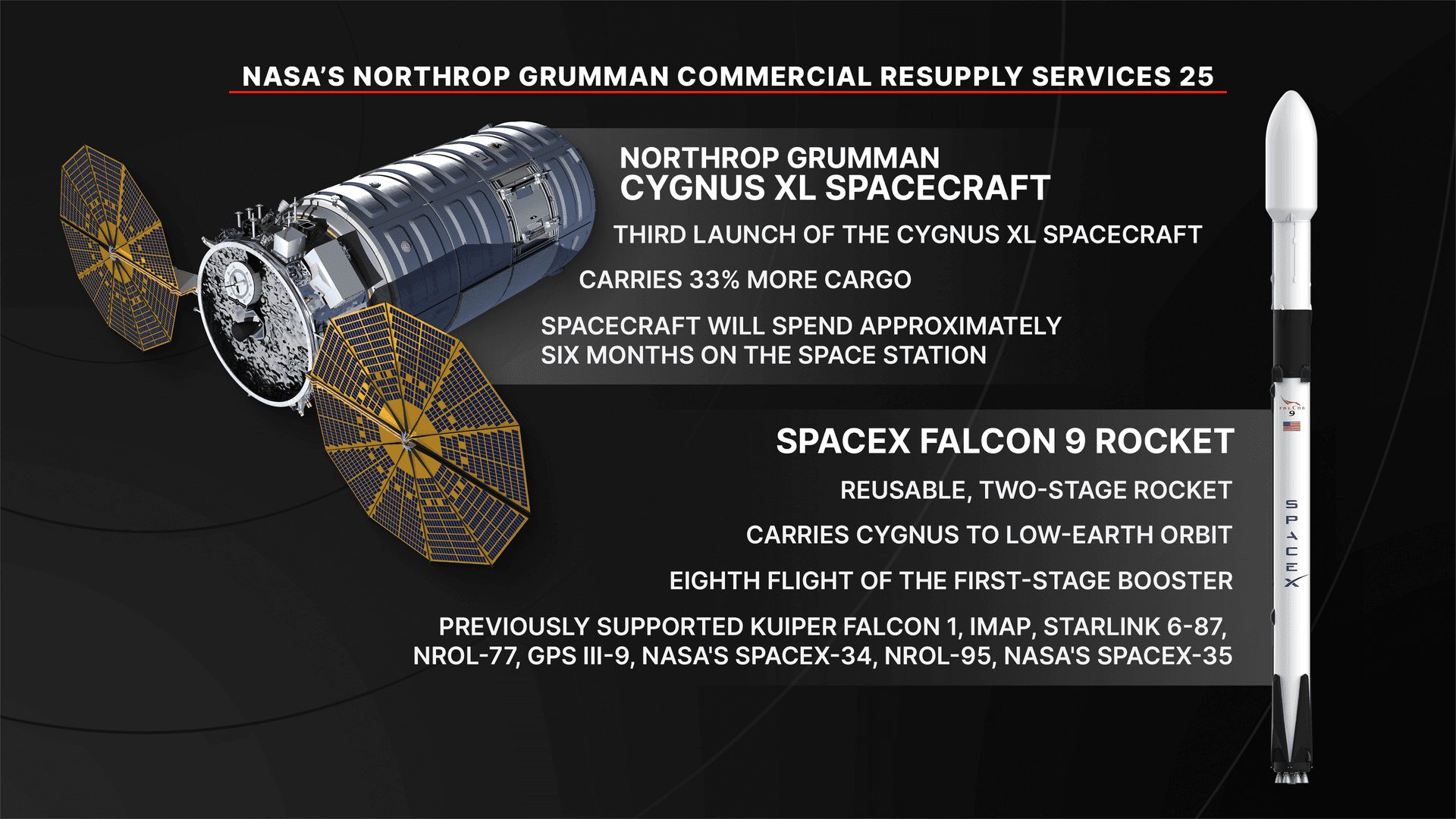
The CRS‑25 mission will deliver about 11,000 pounds of science and supplies to the ISS, making it one of the most substantial resupply flights this year. It is the third flight of the Cygnus XL, a larger, more cargo‑capable version of Northrop Grumman’s solar‑powered spacecraft. The vehicle carries the name “Jim Lovell” in tribute to the veteran astronaut who flew Gemini, Apollo and the historic Apollo 13 mission. In addition to food, clothing and spare parts, the cargo includes a suite of experiments designed to advance drug delivery, muscle‑loss treatment, radiation sensing, and food production for future deep‑space missions.
Launch and Docking Operations
CRS‑25 will launch on a SpaceX Falcon 9 from Space Launch Complex 40 at Cape Canaveral Space Force Station in Florida. After liftoff, the Cygnus XL will perform a series of orbital maneuvers to approach the ISS. Upon arrival, astronauts Jessica Watkins and Luke Delaney will monitor the spacecraft; Watkins will operate the Canadarm2 robotic arm to grapple Cygnus, while Delaney tracks its trajectory. Ground controllers will then robotically berth the vehicle to the Unity module’s Earth‑facing port, where the station’s crew will begin unloading the cargo. This coordinated sequence ensures a safe and efficient transfer of over five metric tons of material.
Scientific Payloads
The CRS‑25 cargo includes five high‑priority investigations. Cardinal Muscle 2.0 will test FDA‑approved drugs on engineered human muscle cells to combat sarcopenia, a condition that mirrors astronaut muscle atrophy and age‑related loss on Earth. DNA Nano B aims to fabricate DNA‑inspired nanomaterials in microgravity for targeted delivery of medicines to cartilage and solid tumors. The Active Radiation Environment Sensor (ARES) will validate a compact radiation monitor intended for future Artemis crews. Encapsulate‑1 will grow patient‑derived tumor micro‑samples aboard the station to study metastasis mechanisms. Finally, OHALO III will evaluate automated plant‑growth systems that could support food production on long‑duration missions.
Technology Demonstrations and Mission Hardware
Beyond scientific research, CRS‑25 will demonstrate the JOINS (Joining Demonstrations IN‑Space) robotic welding experiment inside the Bishop Airlock. JOINS will test laser‑beam welding and friction‑stir welding on aluminum and stainless‑steel samples, proving that large structures can be assembled or repaired in orbit. The mission also transports essential hardware: crew‑quarter blankets, hatch‑seal covers for U.S. segment hatches, a modified toilet pretreat hose, Alpha Magnetic Spectrometer tools for upcoming spacewalks, and batteries for the Anomaly Gas Analyzer. These items support day‑to‑day station operations and future extravehicular activities.

Join the Conversation
Moderated reader discussion · Community standards apply