

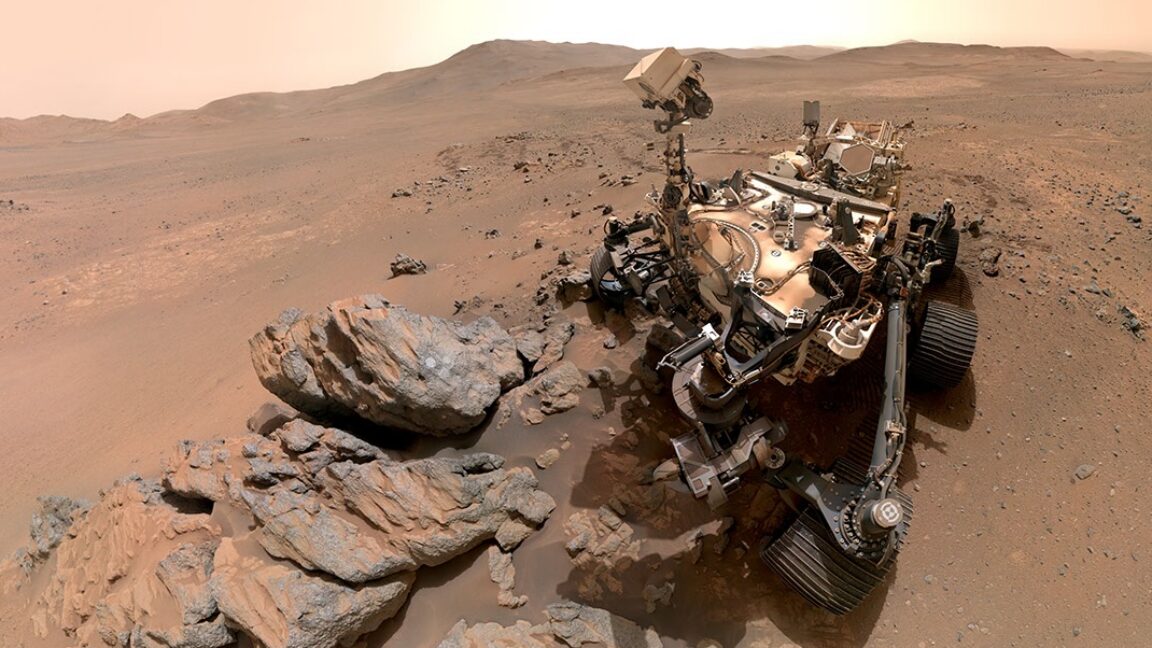
Perseverance Loses Both UHF Radios
The Perseverance rover entered safe mode on October 30 after one of its two redundant UHF radios failed to respond during power-up. Ground teams at NASA's Jet Propulsion Laboratory later discovered the backup UHF radio was transmitting at roughly half its expected power output. NASA has suspended use of both radios pending further evaluation. The rover is now communicating directly to Earth via its X-band system, which provides a significantly lower data rate than relaying through orbiters. Mission managers paused science operations out of an abundance of caution. Their priority is recovering the backup UHF radio before addressing the primary unit. NASA said the team is hopeful Perseverance could resume science by the end of November. The rover recently set a record for the farthest distance driven by any vehicle on another planet, surpassing the 28.06-mile mark set by the Opportunity rover.
Odyssey Orbiter Faces Fuel Crisis
The situation aboard the Odyssey orbiter is more serious. One of its four reaction wheels stopped spinning in early November, leaving the spacecraft with only two functional wheels after a first failure in 2013. Odyssey requires at least three reaction wheels to maintain proper orientation for pointing its solar arrays and science instruments. Without three healthy wheels, the orbiter must rely on hydrazine thrusters to stay oriented. Engineers estimate the spacecraft now has enough propellant to operate for only one to two months. Odyssey, which arrived at Mars in 2001 and is the longest-lived Mars mission in history, had been projected to operate through at least 2028 under its previous low-fuel-consumption plan—assuming no further reaction wheel failures. Ground teams reported initial success in troubleshooting the malfunctioning wheel, but further testing is needed to determine whether it can be recovered.
Aging Mars Infrastructure Under Strain
Odyssey is one of four orbiters NASA uses to relay communications between Earth and the Perseverance and Curiosity rovers. The other relay craft include NASA's Mars Reconnaissance Orbiter, the European Space Agency's ExoMars Trace Gas Orbiter, and ESA's Mars Express. NASA lost contact with its MAVEN orbiter in December 2025 after the spacecraft spun out of control; engineers concluded a radiation-induced event or software issue caused a flight computer reboot. NASA is preparing to send reinforcements: Blue Origin holds a $700 million contract for the Mars Telecommunications Network orbiter, though the project is on hold pending a Government Accountability Office ruling on a protest filed by Rocket Lab. Another mission, SkyFall, could launch in 2028 to deploy three helicopter drones at Mars. NASA is also in early stages of developing a successor to the Mars Reconnaissance Orbiter's high-resolution mapping camera, but no firm schedule or budget exists.




Join the Conversation
Moderated reader discussion · Community standards apply