

DragonCam's Seven-Camera Imaging Suite
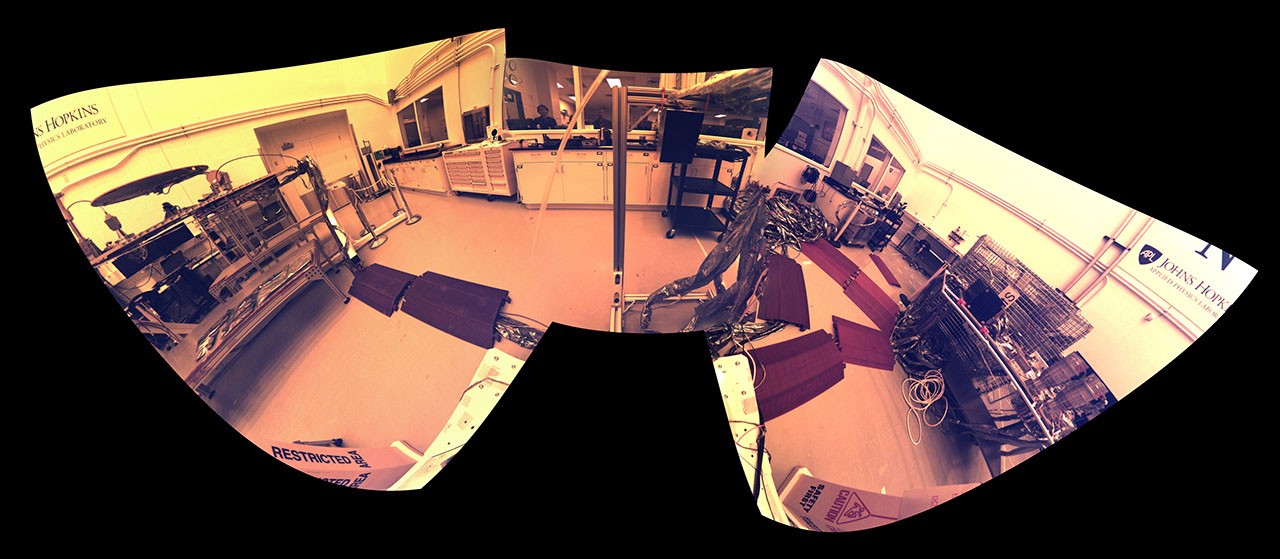
DragonCam consists of seven cameras developed and built by Malin Space Science Systems, all installed in insulated housings by mid-November 2026. Each camera looks out at Titan through a window in a foam enclosure that protects the cameras and Dragonfly's interior from Titan's cryogenic environment, where ambient temperatures reach minus 290 degrees Fahrenheit. A configurable LED array built at APL spans the light spectrum from infrared to ultraviolet, providing information about surface material colors at sampling sites and helping scientists infer composition. During Titan's nearly eight-Earth-day night, these observations may allow DragonCam to identify organic molecules that fluoresce under ultraviolet light.
Camera Configuration and Capabilities
Two forward-mounted cameras — a wide-angle camera and medium-angle camera — capture terrain images in front of Dragonfly. The forward WAC offers a 90-degree field of view, while the forward MAC overlaps with the WAC at higher resolution, together providing stereoscopic perspective. Two additional side-mounted WACs enable panoramic views of the Titan landscape. Two downward-facing WACs provide views of the surface beneath Dragonfly, helping the team assess landing safety for deploying the DrACO sampling tool and seismometer. A high-resolution microscopic imager targets DrACO's drill site to examine millimeter-sized sand grains around the sampling location.
Scientific Objectives and Principal Investigator Perspective
Dragonfly principal investigator Elizabeth Turtle at APL emphasized the mission's novel perspective: "One of the most exciting things about Dragonfly is that we'll be able to see Titan from perspectives we've never had before." DragonCam will provide both detailed views and sweeping panoramas of Titan's landscape, offering insight into the processes that shaped the world. DragonCam instrument scientist Carolyn Ernst noted the cameras will give critical context for samples collected by DrACO across multiple Titan sites, helping relate samples to the broader landscape and piece together the story of its geology.
Mission Timeline and Remaining Instrument Delivery
Components of Dragonfly's other instrument packages — DraGNS, DraGMet, DraMS, and DrACO — are scheduled for delivery, integration, and testing over the coming months. Dragonfly is scheduled to launch in July 2028 and reach Titan in late 2034. The DragonCam integration marks a significant milestone in the rotorcraft's assembly at APL. Michael Ravine, DragonCam development manager at Malin Space Science Systems, expressed satisfaction at delivering the cameras: "Now to have them on the Dragonfly spacecraft, taking images, it's so much easier to picture how they will work on Titan. These will be our eyes to see and explore this whole new world."


Join the Conversation
Moderated reader discussion · Community standards apply