

The Featured Image
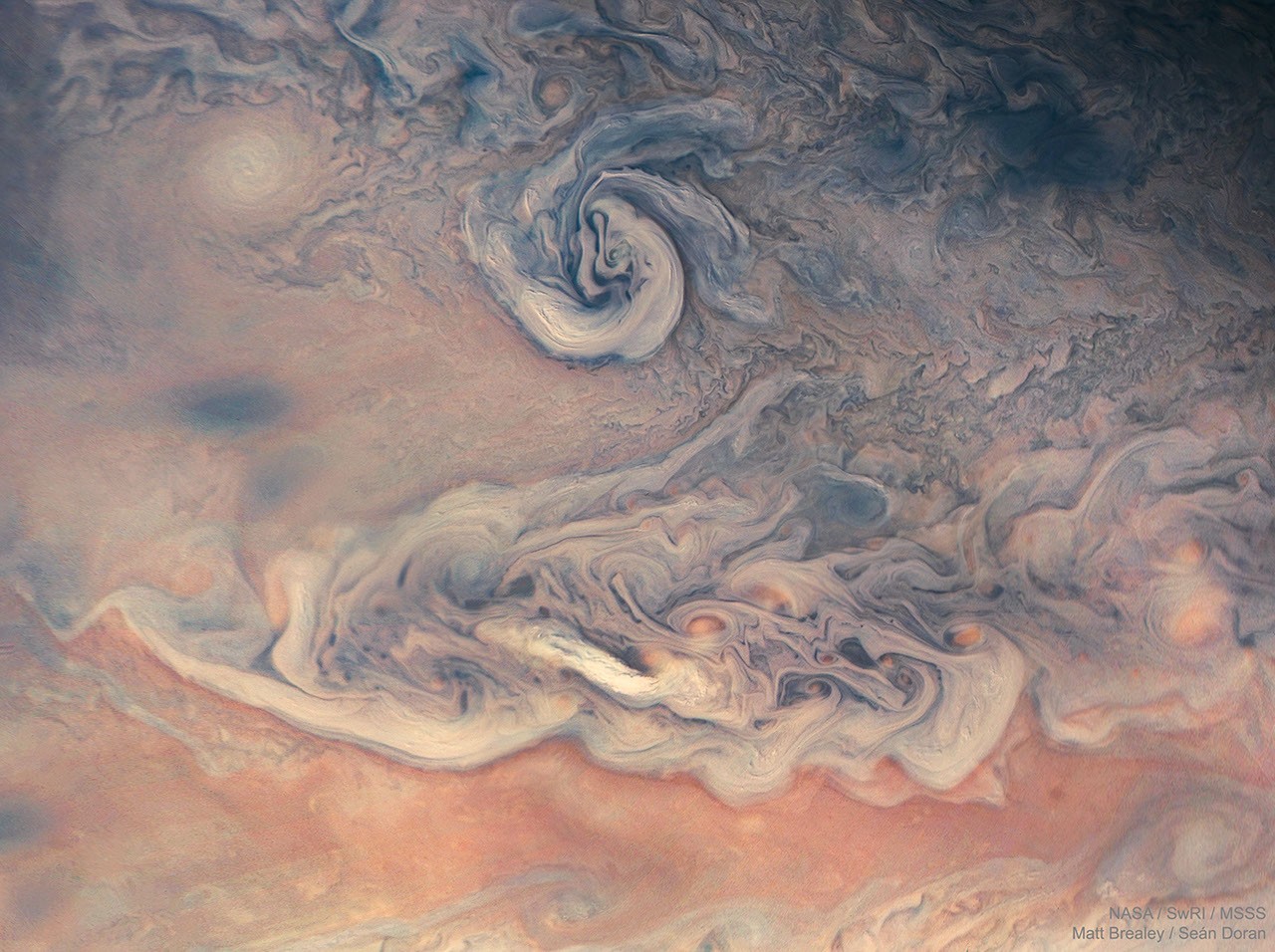
The color-enhanced photograph showcased in this APOD entry was taken by the robotic Juno spacecraft in 2018 during its 14th low pass over Jupiter. The image captures light clouds swirling around reddish regions toward the lower right of the frame, while those same light clouds appear to cover over some darker domains on the upper right. The processing and licensing credit goes to Matt Brealey and Seán Doran, with the underlying data provided by NASA, Juno, SwRI, and MSSS. The image exemplifies the kind of detailed atmospheric observation that Juno has been delivering since its arrival at Jupiter.
The Mystery of Jupiter's Colors
What creates the colors in Jupiter's clouds? According to the APOD explanation, no one is sure. Jupiter's thick atmosphere consists mostly of hydrogen and helium, elements that are colorless at the low temperatures found at the Jovian cloud tops. Which trace molecules provide the observed colors remains an active topic of research. Small amounts of ammonium hydrosulfide are identified as one leading candidate for producing the hues seen in the image. This ongoing scientific question underscores why continued observation of Jupiter's atmosphere is valuable to researchers.
Cloud Altitude Patterns
What is clear from the featured color-enhanced image, and from many similar images, is that lighter clouds on Jupiter are typically situated higher up than darker ones. This altitude distinction provides researchers with a visual cue about the vertical structure of the planet's atmosphere. In the featured photograph, the lighter swirls stand out against the darker and reddish regions, offering a glimpse into the complex layering of Jupiter's cloud systems. Such patterns help scientists piece together how Jupiter's atmosphere is organized at different depths.
Juno's Ongoing Mission
Juno continues in its looping elliptical orbit around Jupiter, swooping near the huge planet every 33 days and exploring a slightly different sector each time around. This orbital strategy allows the spacecraft to gather data from diverse regions of the Jovian atmosphere over time. The featured image, captured during Juno's 14th low pass, is one product of this systematic survey. The APOD entry was authored and edited by Robert Nemiroff, Jerry Bonnell, Cecilia Chirenti, and Keighley Rockcliffe, as a service of the Astrophysics Science Division at NASA's Goddard Space Flight Center.
Join the Conversation
Moderated reader discussion · Community standards apply