

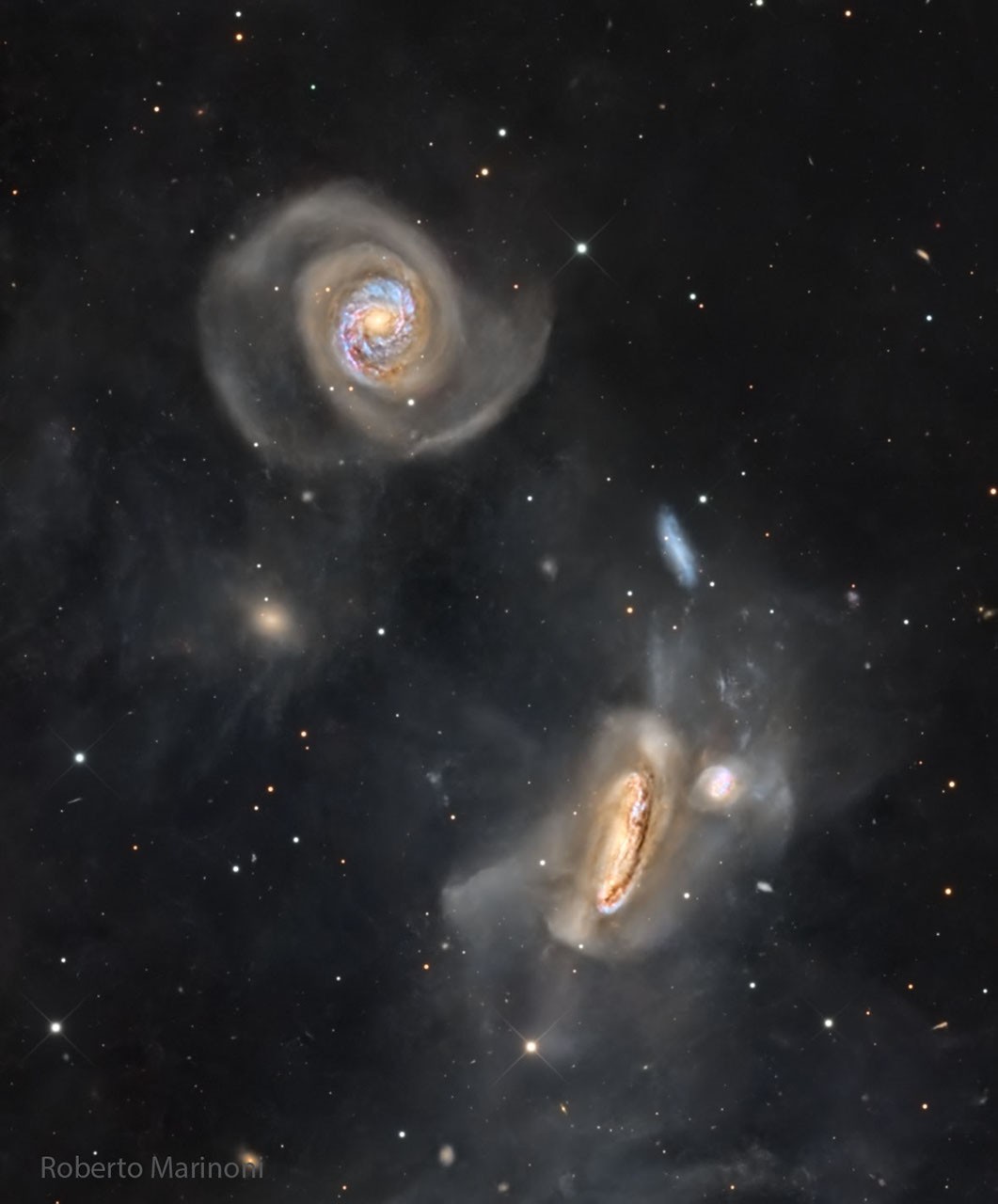
A Cosmic Collision in Progress
The NGC 7771 Group is currently undergoing a dramatic gravitational battle among its member galaxies. The featured APOD image already displays visible rings and faint star swirls, structures produced by past close gravitational encounters between the galaxies. These tidal features serve as evidence of the ongoing interactions reshaping the group. Located almost 200 million light-years from Earth toward the constellation Pegasus, the NGC 7771 Group presents astronomers with a nearby laboratory for studying how galaxies evolve through collision and merger processes over cosmic timescales.
The Principal Galaxies: NGC 7771 and NGC 7769
The largest galaxy in the group is the barred spiral NGC 7771, positioned on the lower right of the image. It measures approximately 75,000 light-years across, making it somewhat smaller than our own Milky Way. On the upper left sits the spiral galaxy NGC 7769, which is almost as large as NGC 7771. Both galaxies, along with other smaller members of the group, are engaged in repeated close gravitational passages. These interactions are gradually stripping material from the galaxies and pulling them toward an eventual merger into a single, very large galaxy.
Merger Timescales and Galactic Evolution
The merger of the NGC 7771 Group galaxies is expected to play out over billions of years, a timescale that reflects the slow but relentless nature of gravitational interactions between massive objects. According to the APOD explanation, this merger process is understood to be a normal part of galaxy evolution. Galaxies across the universe frequently undergo such mergers, growing in size and changing in structure as a result. The NGC 7771 Group provides a clear, observable example of this universal process at work.
Implications for the Milky Way and Andromeda
Studying galaxy clashes like those occurring in the NGC 7771 Group helps astronomers better understand the possible future merger between our own Milky Way galaxy and the Andromeda galaxy. By observing how galaxies interact, distort, and eventually combine at various stages, researchers can refine models of what may happen when the Milky Way and Andromeda undergo their own gravitational encounter. The NGC 7771 Group thus serves as a valuable cosmic analogue for predicting the long-term fate of our local galactic neighborhood.
Join the Conversation
Moderated reader discussion · Community standards apply