

Reading a Star's History in Its Dust
Stars begin their lives as large clouds of mostly hydrogen gas and cosmic dust called molecular clouds. Gravity causes these clouds to collapse, forming protostars that eventually fuse hydrogen into helium, becoming full-fledged stars. As hydrogen in the core runs out, the core contracts and heats until helium begins to fuse into heavier elements. This process repeats, with increasingly heavier elements fusing in the core and lighter elements fusing in surrounding layers, producing multiple shells that record a star's evolutionary history. When a star goes supernova, these elements scatter into space and some condense into dust grains that can clump together, preserving a chemical record of the star's interior structure.
Evidence of a Shell Merger Before Explosion
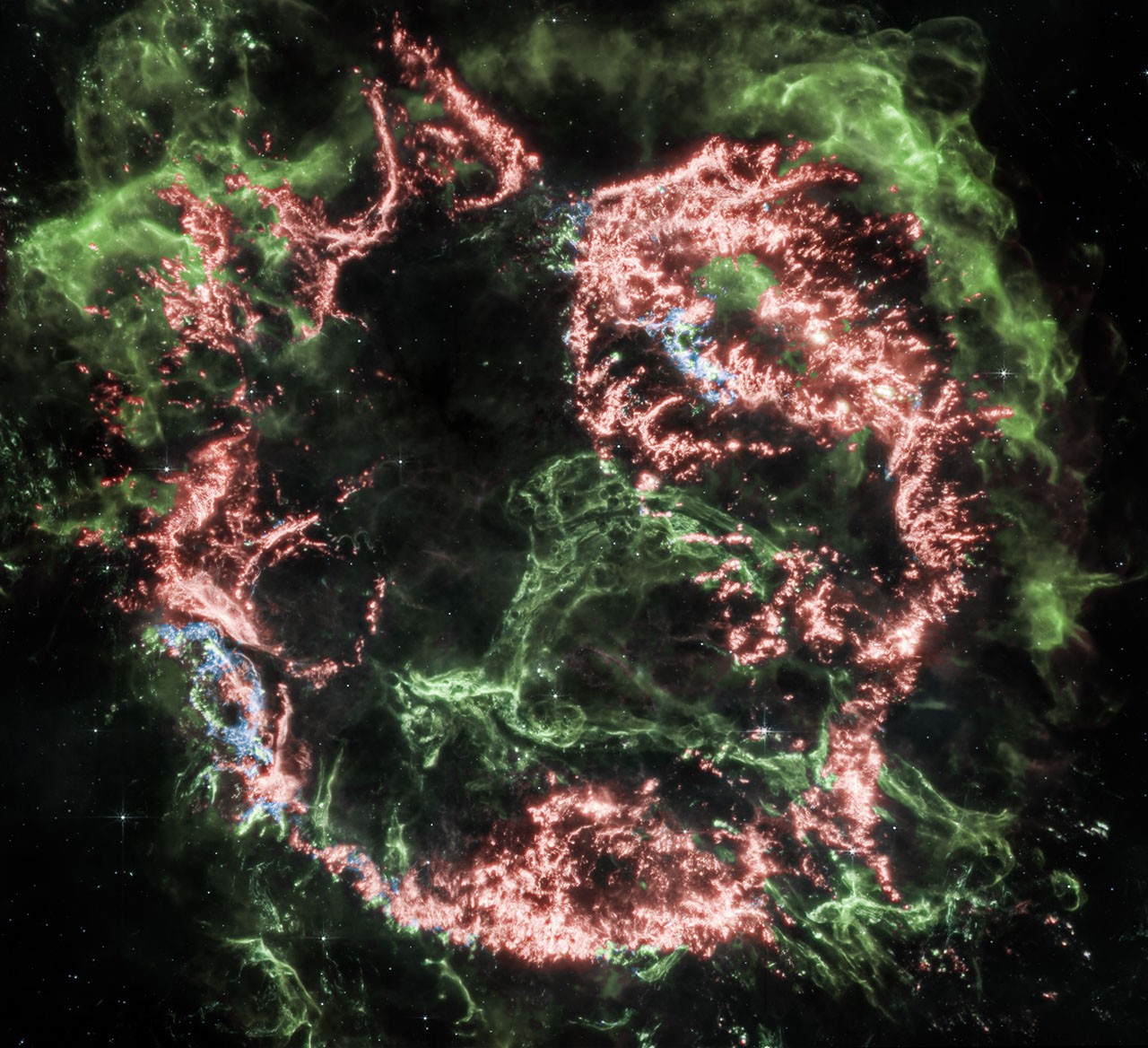
By studying and mapping the composition of individual, solar-system-sized dust clumps in Cas A, Webb found evidence of a shell merger, a process in which the layers inside a star mix before the explosion. Lead author Tea Temim of Columbia University explained that material within these shells churns and circulates, which can cause the shells to merge shortly before the supernova. For example, oxygen- and carbon-burning shells in a star can merge together, significantly changing the star's structure and altering the chemical abundances visible after the explosion in the supernova remnant's ejecta.
Targeted Observations Build on Spitzer Legacy
To determine where to point Webb, researchers leveraged data from NASA's retired Spitzer Space Telescope, which identified three specific regions for Webb to observe. Two targets were inside Cas A's reverse-shocked region, where an inward-moving shock wave collides with debris thrown outward by the supernova. Webb found that one region contained mostly silica dust while the other was dominated by carbon dust. The third target, the 'Green Monster' — a structure first discovered by Webb — was rich in complex magnesium silicates and originated from material the star shed before exploding, rather than from the supernova's ejecta.
A New Method for Probing Progenitor Stars
Building on X-ray observations from NASA's Chandra X-ray Observatory and the JAXA-led XRISM, Webb mapped the dust composition of Cas A across the entire remnant, providing crucial insight into the shell merger phenomenon. Co-author Dan Milisavljevic of Purdue University noted that Webb's ability to resolve individual clumps enables more sophisticated dust chemistry, tying the explosion back to the progenitor star's makeup hundreds of years afterward. The dust map reveals merger signatures throughout much of the remnant, establishing a new method for astronomers to infer originating star characteristics from supernova remnant dust.
Join the Conversation
Moderated reader discussion · Community standards apply