

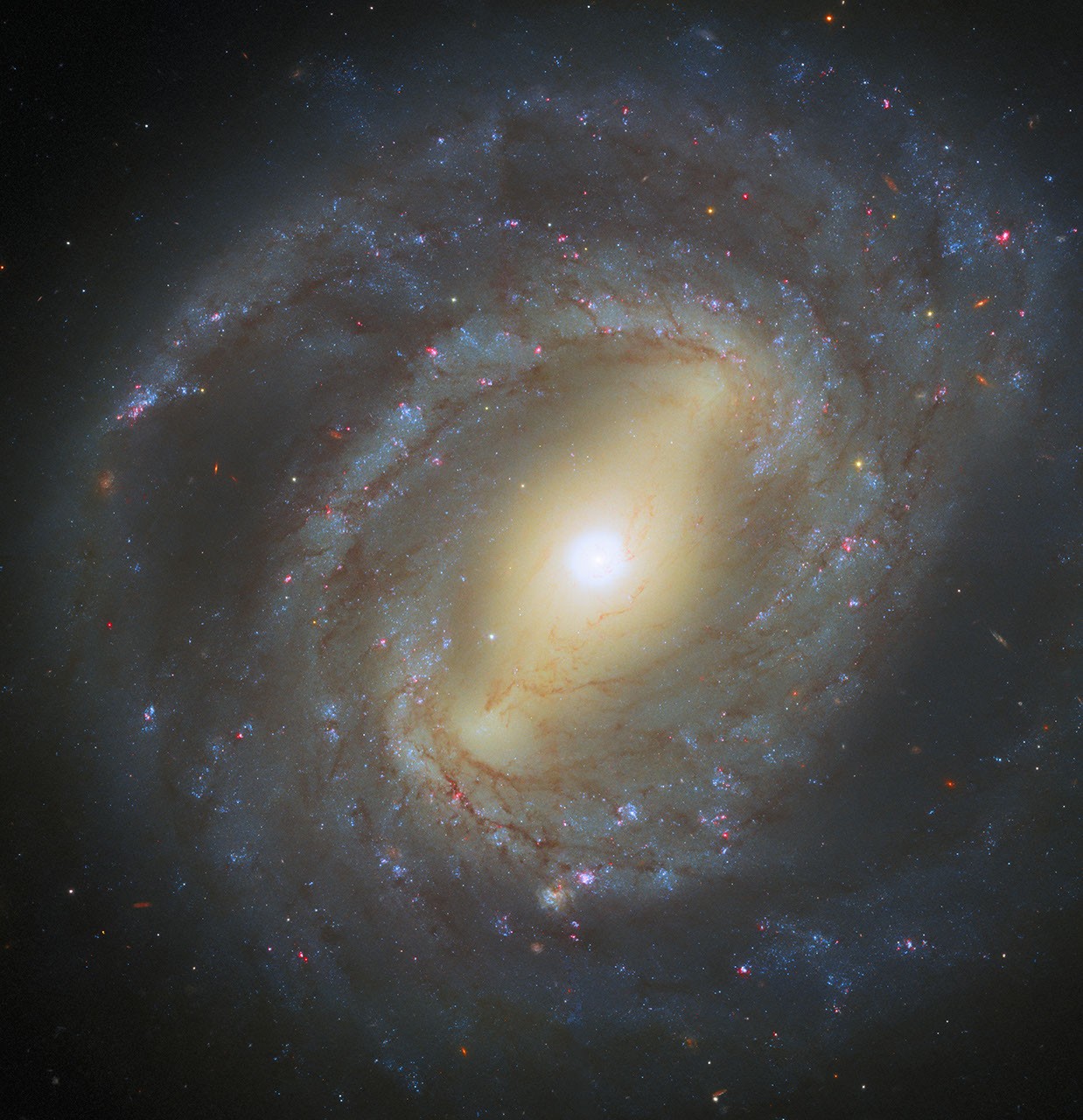
A Galactic Look-Alike
NGC 4394 is one of more than 1,000 galaxies that make up the Virgo Cluster, the galaxy cluster closest to Earth. At roughly 55 million light-years away, it is considered relatively nearby in cosmic terms. With its graceful spiral arms and distinct central bar of stars, NGC 4394 closely resembles what astronomers believe the Milky Way would look like if viewed from a similar face-on perspective. This resemblance makes NGC 4394 a compelling subject for astronomers studying the structure and evolution of barred spiral galaxies, including our own home galaxy.
The Science of Galactic Bars
Galactic bars are extremely common in the universe; astronomers estimate that 65 percent of nearby spiral galaxies have one. Hubble has imaged a wide variety of stunning barred spirals, including NGC 5728, NGC 685, and NGC 613. Explanations for how these bars form tend to center on a galaxy's disk of stars becoming unstable—possibly due to gravitational nudges from passing galaxies or interactions between stars. Once unstable, the circular orbits of stars become elongated, producing the barred shape. Observations show bars are more common today than several billion years ago, though research suggests this trend may be temporary as bars become more massive and potentially unstable themselves.
A Shared Nuclear Feature
Beyond their stellar bars and spiral arms, NGC 4394 and the Milky Way share another important similarity: both may contain a LINER, or low-ionization nuclear emission-line region. A LINER refers to an area near a galaxy's center where its spectra feature certain ionized or neutral elements. Researchers have not yet determined exactly how LINERs form, though either hungry supermassive black holes or intense star formation likely play a role. This shared characteristic adds to the growing body of evidence that NGC 4394 serves as a valuable analog for understanding the processes at work within our own galaxy's core.
Hubble's Repeat Observations
Hubble has observed NGC 4394's patch of sky more than once. A previous image released a decade ago came from observing program #10515, led by PI Peng, which focused on NGC 4394's neighbor Messier 85. While one instrument studied Messier 85's unusual star clusters, the Advanced Camera for Surveys captured NGC 4394 in a parallel field. The new image incorporates data from program #18103, led by PI Thilker, which used Hubble's Wide Field Camera 3 to determine the ages of individual star clusters in 40 galaxies, examining how star formation ends in dense cluster environments versus isolated galaxies.


Join the Conversation
Moderated reader discussion · Community standards apply