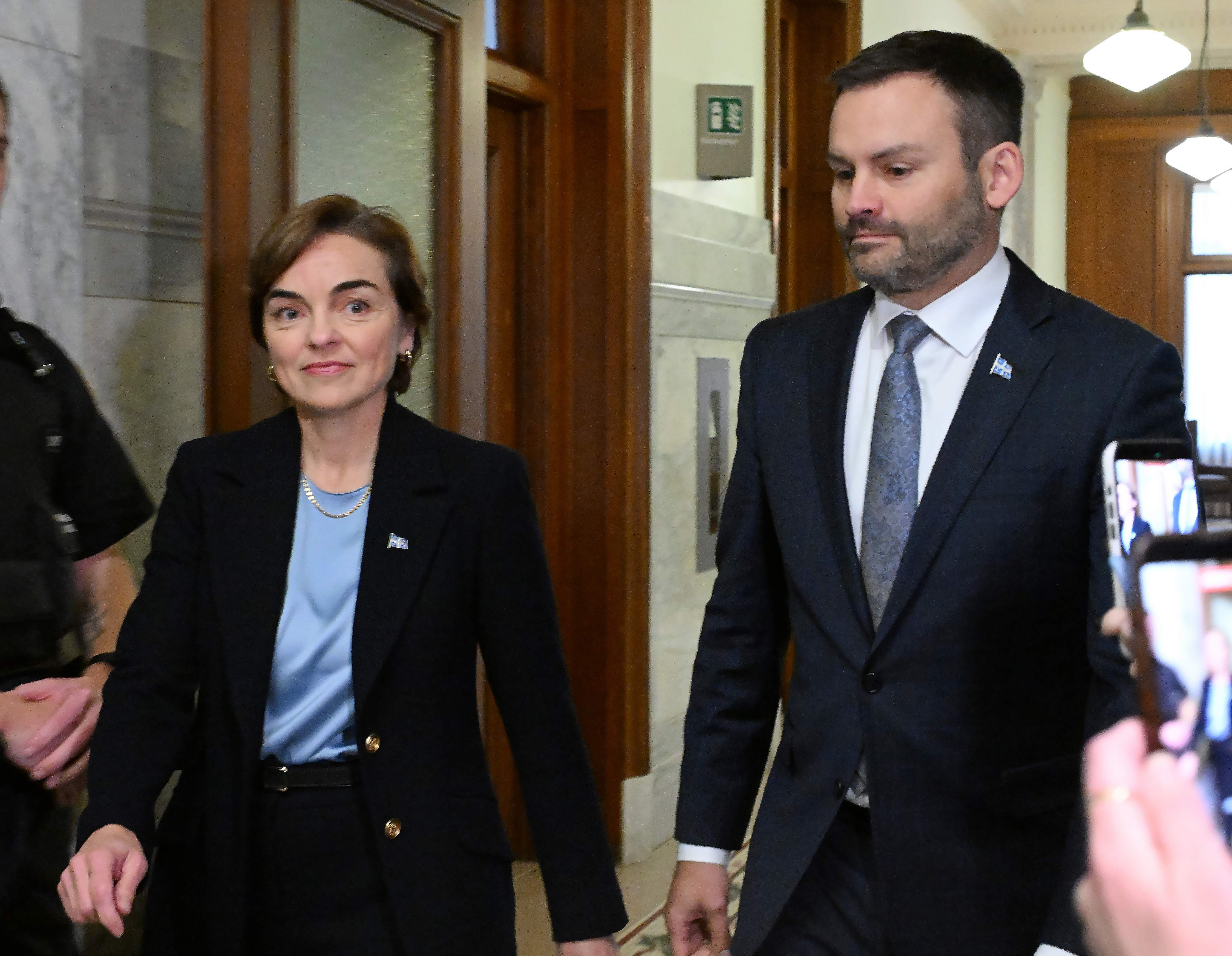
Quebec's transition of power formally began Tuesday as outgoing Premier Christine Fréchette met with premier-designate Paul St-Pierre Plamondon at the premier's office in Quebec City. The nearly 50-minute meeting covered urgent economic issues facing the province, including employment, relations with the United States, and the Churchill Falls hydroelectric agreement with Newfoundland and Labrador. The transition follows Quebecers' October 5 election of a minority Parti Québécois government, returning the sovereigntist party to power for the first time since 2014. St-Pierre Plamondon expressed satisfaction with the talks and emphasized the need for an orderly, collaborative transition, while Fréchette stressed the importance of a coordinated handover between their teams. The meeting between Fréchette and St-Pierre Plamondon lasted just under 50 minutes and focused on several major challenges confronting Quebec. According to St-Pierre Plamondon, the two leaders discussed the economy, employment, relations with the United States, and the Churchill Falls hydroelectric agreement with Newfoundland and Labrador. Speaking to reporters in French after the meeting, St-Pierre Plamondon said, 'We touched on all kinds of urgent and sensitive issues.' He expressed satisfaction with the discussions and thanked Fréchette's team for its cooperation, stating, 'We are looking at an orderly transition, marked by collaboration.' Fréchette similarly emphasized the importance of ensuring a smooth handover, telling reporters, 'It's important to ensure a co-ordinated, proper transition. Our teams will exchange information on the next steps.' The transition comes eight days after Quebec voters elected a minority Parti Québécois government on October 5, marking the party's return to power for the first time since 2014. The PQ secured 59 seats in the National Assembly, while the Quebec Liberals won 40 seats to form the official Opposition. The Conservatives captured 19 seats, and Québec solidaire took nine. In a dramatic shift, the Coalition Avenir Québec, which had governed Quebec since 2018, failed to elect a single member. Fréchette announced the day after the election that she was resigning as CAQ leader, taking 'full responsibility' for the party's defeat. While the transition proceeds, St-Pierre Plamondon is already signaling a different approach as he prepares to lead a minority government. Newly elected PQ members are scheduled to be sworn in as members of the National Assembly on Thursday, but it remains unclear whether St-Pierre Plamondon will pledge allegiance to the King—an issue currently facing legal challenge. Daniel Béland of the McGill Institute for the Study of Canada noted that while the issue is not new, its prominence in the incoming government's agenda remains uncertain. 'At the same time, the question is to know whether he will really focus on this because he said his priorities are homelessness, the cost of living, government spending and so forth,' Béland told Global News. With 59 seats, the PQ will need support from opposition parties to pass legislation, requiring St-Pierre Plamondon's government to find common ground with political opponents. Béland suggested the PQ could turn to different parties depending on the issue. 'In terms of some issues related to government spending, reducing the size of public services, that is something they can do with the Conservatives,' he said. 'When we need social issues or homelessness and so forth, certainly Québec solidaire is keen on social spending.' The incoming government also faces a significant learning curve, with more than 50 PQ MNAs new to provincial politics and limited representation in Montreal and the Quebec City area. 'It's a challenge for any new government, but when you're in minority territory you have to be especially disciplined,' Béland said. 'And on top of it, when most of your MNAs are rookies, at least to provincial politics as elected MNAs to the national assembly, I think that this adds to the challenges that this government is facing.' St-Pierre Plamondon is expected to unveil his cabinet next week. He and his cabinet are scheduled to be sworn in on October 21, when he will officially move into the premier's office. The transition process continues as the PQ also challenges results in two closely contested ridings, adding further complexity to the party's path forward. The transition is unfolding as the PQ contests results in two tight races. A party source said Tuesday the PQ is seeking a judicial recount in Champlain, in the Mauricie region, where Conservative Adriana Szalontai defeated PQ candidate René Branchaud by 191 votes. The source said alleged irregularities were identified during ballot counting, with approximately 80 ballots missing from one ballot box and another 30 from a second. While the margin in Champlain does not meet the threshold under Quebec election law—which allows a recount when the margin between top candidates is less than one-thousandth of votes cast—the PQ official said the party believes it has sufficient grounds to convince the Court of Quebec to grant the request. The Court of Quebec has already granted the PQ's request for a recount in Vachon, where Liberal Affine Lwalalika defeated PQ candidate Stephan Fogaing by 10 votes. That recount is scheduled to begin October 19 and is expected to last three days.
Quebec's Incoming, Outgoing Premiers Meet as Transition of Power Begins
Quebec's transition of power formally began Tuesday as outgoing Premier Christine Fréchette met with premier-designate Paul St-Pierre Plamondon at the premier's office in Quebec City. The nearly 50-minute meeting covered urgent economic issues facing the province, including employment, relations with the United States, and the Churchill Falls hydroelectric agreement with Newfoundland and Labrador. The transition follows Quebecers' October 5 election of a minority Parti Québécois government, returning the sovereigntist party to power for the first time since 2014. St-Pierre Plamondon expressed satisfaction with the talks and emphasized the need for an orderly, collaborative transition, while Fréchette stressed the importance of a coordinated handover between their teams.
News Station Editorial Desk
We adhere to strict accuracy standards. Spotted a factual typo or outdated detail?